REVIEW · CAPE TOWN
Private City Tour Table Mountain + Cable Car Ticket Camps Bay H/D
Book on Viator →Operated by Raw African Safaris · Bookable on Viator
Cable car views, history stops, done in one morning. This private city tour is built for people who want the big Cape Town hits without wrestling buses, with Table Mountain and a string of major neighborhoods and museums packed into about 4–5 hours. You also get a real driver-guide flow, so you’re moving between overlooks and districts while someone else handles the timing.
What I like most is the efficiency: you get dramatic viewpoints plus cultural stops in one go, and the cable car component is included. I also like the door-to-door pickup/drop-off from the Victoria & Alfred Waterfront area, because Cape Town is much easier when you start and end right where you’re staying.
One thing to consider: this experience requires good weather, so if visibility is poor you may want a flexible mindset. Also, the pacing is brisk—many stops are short—so it’s best if you’re okay with seeing the highlights rather than lingering all day.
In This Review
- Key Things You’ll Notice on This Half-Day Route
- How This Private Route Fits Into 4–5 Hours
- Starting at the Waterfront: Why the Pickup Choice Helps
- Cape Town Stadium and Sea Point Stops: Quick City Views from the Road
- Camps Bay Beach: Blue-Flag Shoreline with Table Mountain in View
- Table Mountain Cable Car: The Fastest Way to Reframe the City
- Signal Hill at Noon: 360 Degrees and the Cannon Moment
- Bo-Kaap: Colorful Streets Plus Real Community Context
- Company’s Gardens: Old Garden, Trade-Route Backstory, and Birdlife
- Iziko Slave Lodge and District Six Museum: When the Tour Turns Serious
- Castle of Good Hope: Dutch Colonial Power and a Daily Cannon Tradition
- Price and Value: What $165.78 Gets You (and Why It’s Not Just a Deal)
- Who This Tour Suits Best (and Who Might Want Something Slower)
- Should You Book This Private Table Mountain + City History Tour?
- FAQ
- How long is the tour?
- Is this a private tour?
- Where does the tour start and end?
- What’s included in the price?
- What isn’t included?
- Which major stops are part of the route?
- What about weather?
- Can I bring a service animal?
- What if I need to cancel?
Key Things You’ll Notice on This Half-Day Route
- Private door-to-door transport keeps you from wasting time on transfers and crowded group lines
- Table Mountain Cable Car is part of the plan, so the key view isn’t left to chance
- Signal Hill includes the daily 12 noon cannon and big 360-degree panorama potential
- Bo-Kaap brings the color and the context, including the Malay community and heritage storytelling
- You’ll pair scenic stops with hard history at Iziko Slave Lodge and the District Six Museum
- Castle of Good Hope wraps the story with Dutch-built colonial architecture and a daily cannon tradition
How This Private Route Fits Into 4–5 Hours
This tour is designed for a short visit. You’re looking at a half-day format that still hits a lot of major Cape Town landmarks: mountain views, seaside neighborhoods, colorful historic streets, and multiple museums tied to colonial and apartheid-era history. In other words, it’s not just postcard Cape Town. It’s Cape Town with context.
The private setup matters. You’re only with your group, in an air-conditioned vehicle, with bottled water and an accredited guide. That reduces the usual friction—waiting for late people, getting rushed off buses, or missing key photo angles because you’re stuck in a crowd.
The pacing is the trade-off. Most of the time at each major stop is brief, so you’ll need to move with purpose. If you’re the type who likes to read every placard slowly, this might feel like a sprint. If you’re the type who wants to cover the essentials and go deeper later on your own, it’s a smart fit.
A few more Cape Town tours and experiences worth a look



Starting at the Waterfront: Why the Pickup Choice Helps
The meeting point is the Silo Hotel, Silo Square, Victoria & Alfred Waterfront (right in the center of the action). Starting here is practical because it’s a major hub area for getting around and it’s easy to orient yourself before a drive.
Door-to-door transfers also make a big difference in Cape Town, where distances and traffic can throw off a tight schedule. The tour includes pickup and drop-off after the tour ends back at the meeting point, which keeps the logistics simple. If you want a clean half-day with less map work and fewer taxi calls, this structure helps.
There’s also a mobile ticket element. That typically reduces hassle on the day itself, especially when you’re coordinating cable car entry and moving between multiple sites.
Cape Town Stadium and Sea Point Stops: Quick City Views from the Road
On the way through town, you’ll pass the Cape Town Stadium, built for the 2010 World Cup. It seats about 58,000, and the stadium has been the subject of debate because of ongoing maintenance costs for the city. Even if you don’t watch matches, this stop is useful as a landmark—Cape Town’s modern identity is right there beside its older story.
You’ll also see the area around the coast, including details near Sea Point. The itinerary includes a non-functional old lighthouse area and a park space with kid-friendly activity, plus residential apartments and iconic views tied to Robben Island from the shoreline perspective.
From the description of what you pass, it’s a drive-focused segment: you’re getting orientation—where the sea, stadium, and island imagery sit relative to the rest of the city. It’s the kind of context that makes your later mountain and beach stops feel even more real.
Camps Bay Beach: Blue-Flag Shoreline with Table Mountain in View
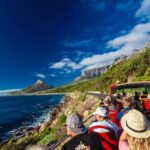
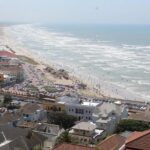
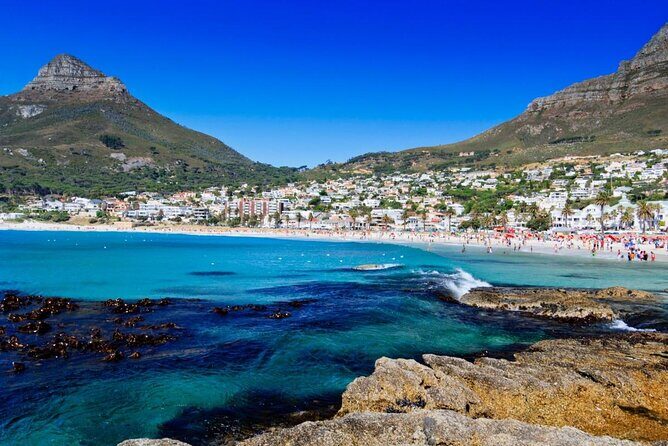
The first classic scenic stop is Camps Bay Beach. This is one of Cape Town’s most popular beaches, and it’s consistently on the Blue Flag list. The beach is described as divided into four sections, and it’s also framed as an area associated with wealth and high-end residences—part of what makes the seaside feel polished and photo-ready.
Here’s the practical value: Camps Bay is ideal for quick photography because you can capture the beach scene with the Twelve Apostles mountains and Table Mountain in the background. You don’t need to hike to get that backdrop. It’s a view you can get while standing on level ground and watching the light change.
Time is short at the beach (about 30 minutes), so I’d think of it as a photo-and-stroll stop, not a full beach day. If you want sand time, plan to extend later with your own transport and more hours.
Table Mountain Cable Car: The Fastest Way to Reframe the City
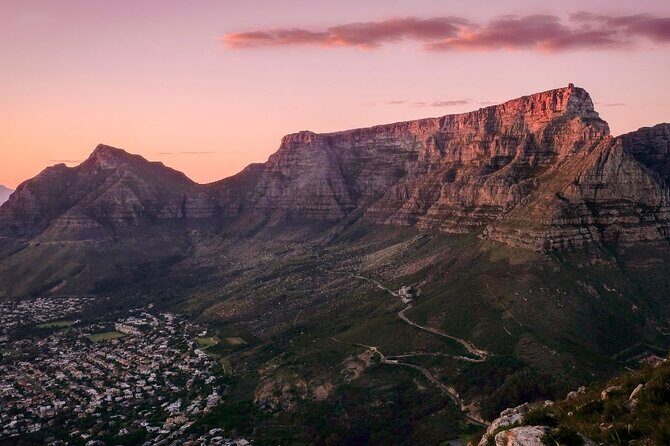
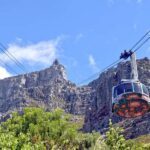
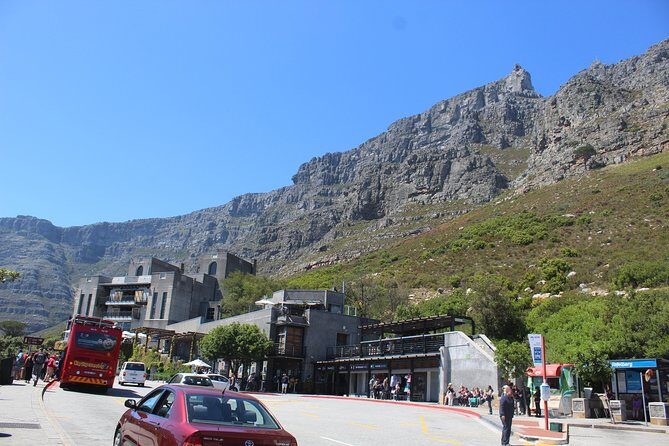
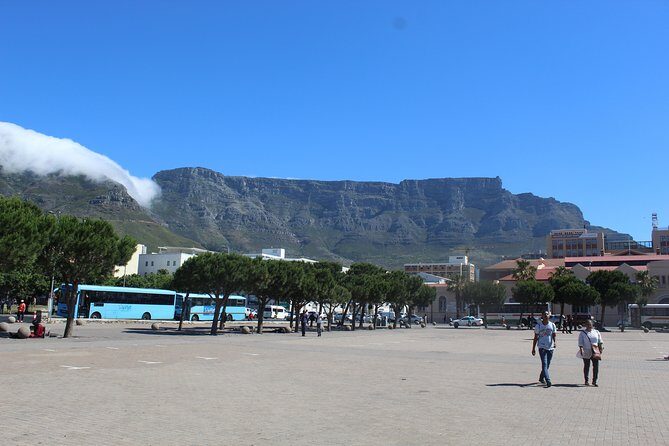
This is the headline: you’ll head to the cable car station at the foot of Table Mountain, then ride up for sweeping city and coastline views. The viewpoint from Table Mountain is described as captivating: you can see the city, surrounding mountains, the ocean, and the big African-blue-sky look that Cape Town does so well.
From up high, you also get a perspective on the coastline stretching toward Bloubergstrand, plus a broader sense of how townships and neighborhoods spread across the terrain. That’s a key part of why this stop works for limited time: you’re not just looking at a mountain. You’re learning how Cape Town is shaped.
One practical note: the tour includes a Table Mountain Cable Car Ticket, and that’s the value anchor. Still, the information also notes optional ticket costs up to R300 per person depending on booking details, so it’s worth checking what’s covered in your specific confirmation message. Don’t assume everything is identical for every date.
Also, this experience depends on weather. If the mountain is socked in, the view suffers. The upside is you’re not paying extra for the cable car component separately in most cases, and the guide can at least help you make sense of what you can see even when visibility is reduced.
You can also read our reviews of more city tours in Cape Town


Signal Hill at Noon: 360 Degrees and the Cannon Moment
After Table Mountain, you’ll head to Signal Hill, one of the best spots in Cape Town for wide-angle city views. From the top, you can see almost 360 degrees, which is exactly what you want when you have only a few hours. The harbor and waterfront, Cape Town’s big stadium landmark, and Robben Island can all show up in the panorama depending on conditions.
The most distinctive detail here is timing: there’s a cannon fired every day at 12 noon. If your schedule lands near that moment, it turns an ordinary overlook into a memorable experience. Even if you arrive a few minutes early or late, the hill is still a powerful viewpoint and a common spot for photos from the “different angle” category.
Signal Hill is also described as a paragliding launching pad, so you might spot gliders during your visit. That adds motion to an otherwise still panorama and helps explain why the hill feels like a living viewpoint rather than a static viewpoint.
Like the beach and other stops, your time up there is about 30 minutes, so it’s smart to keep your camera ready and your legs unburdened.
Bo-Kaap: Colorful Streets Plus Real Community Context
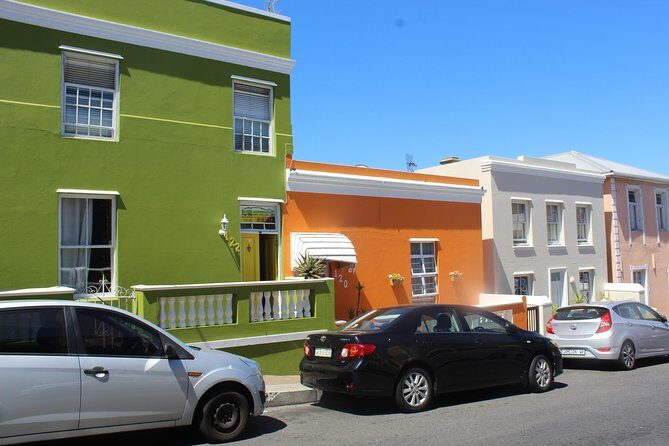
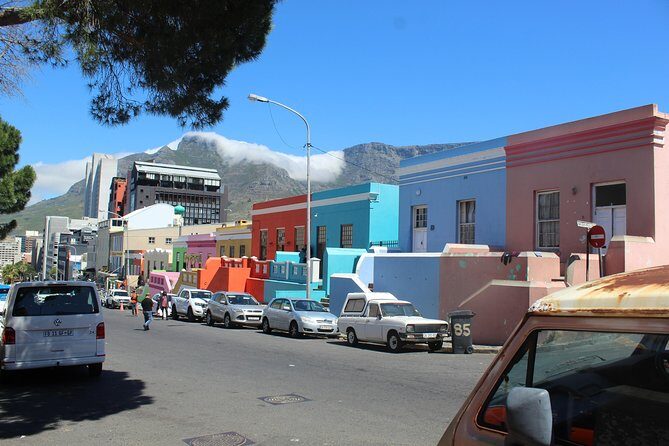
Then you shift from viewpoints into culture at Bo-Kaap. This neighborhood is known for brightly colored houses and is described as the oldest Muslim settlement in South Africa. It’s also noted as having 19 sites declared National Heritage Sites in 2019, which gives the area a strong preservation and recognition angle.
What makes Bo-Kaap more than just a quick photo stop is the way the tour frames it. You’ll get time for photo stops and to experience the cobbled lanes that feel like they’ve kept their texture and character over time.
The itinerary also mentions international students learning English in Cape Town for up to a year—so part of the neighborhood’s current vibe is tied to ongoing community life, not only historic buildings. If you’re traveling with an interest in diaspora and migration stories, this is one of the most direct places on the route to see how history and everyday life overlap.
There’s also a museum mentioned here that provides information about the Malay community and their contribution to Cape Town’s development. That’s a key difference between an Instagram neighborhood stop and a heritage visit.
Company’s Gardens: Old Garden, Trade-Route Backstory, and Birdlife
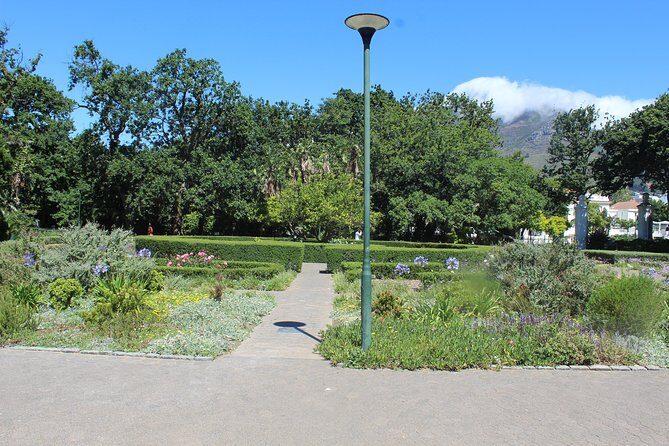
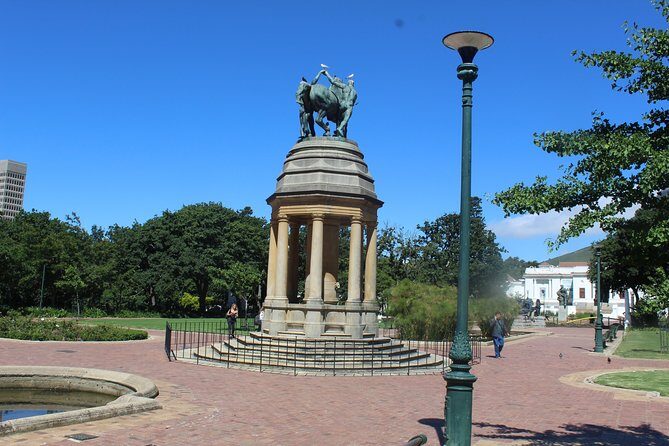
Next is Company’s Gardens, described as the oldest garden in South Africa and a heritage site in the heart of the city. The tour explains it as a refreshment station connected to the trade route that rounded Africa between Europe and the east. That short historical note changes how you see the greenery—you’re not only enjoying a break. You’re moving through space tied to movement and supply routes.
You’ll also see a range of fauna. The description includes Egyptian geese, herons, rodents, squirrels, and an aviary with dozens of bird species. If you like city nature, this is a nice mental reset after steep views and museum intensity.
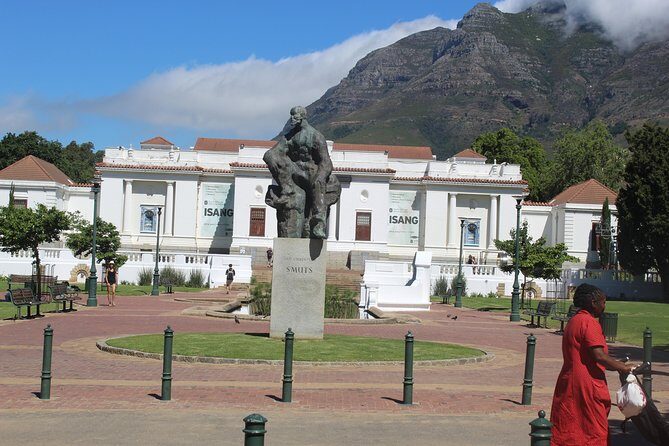
Company’s Gardens also includes the South African Art Gallery, with a permanent collection that spans South African, African, British, French, Dutch, and Flemish art. Even if you don’t do a deep museum read, having this art anchor in a garden setting is a thoughtful pairing and keeps the morning from becoming only viewpoint-and-visit fatigue.
Iziko Slave Lodge and District Six Museum: When the Tour Turns Serious
At Iziko Slave Lodge, the focus shifts to the ills of slavery at the Cape. The tour description says you’ll learn when slavery was introduced and the origins of the slave community and slave masters. There’s also an emphasis on the lived conditions of enslaved people, including information tied to slave trade routes and inhuman equipment used to control and torture.
The inclusion of a video that repeats historical series information suggests you’ll get a structured way to understand the story, not just scattered facts. It’s heavy material, but it matters because it turns the tour from scenery into comprehension.
Then comes District Six Museum, centered on forced removals under apartheid. The information includes key dates: the area was declared whites-only in 1966, and removals took place from 1968 onward. The museum also explains how those removals created township groupings by racial classification.
If you’ve ever felt uneasy about how many places in South Africa have layers that are hard to spot from outside, this is where the route makes that visible. You’ll leave with a clearer sense of how policy shaped real neighborhoods and how loss echoes across generations.
Time here is again about 30 minutes, so you won’t get to absorb everything slowly. Still, the structure helps: you’re guided, you’re shown the context, and you can follow up later if something hits you personally.
Castle of Good Hope: Dutch Colonial Power and a Daily Cannon Tradition
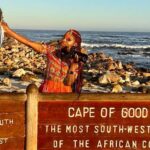
The final major historical stop on this route is the Castle of Good Hope. You’ll see a structure built by the Dutch between 1667 and 1672, described as the oldest standing colonial building in South Africa and among the most preserved Dutch East India Company structures worldwide.
The castle is described as pentagon-shaped and as the center of civilian and military life at the Cape. You’ll also learn how control shifted between Dutch and British governments after changing hands.
The itinerary includes one more memorable detail: a canon fired every day at 12 noon inside the castle. That means noon can be a theme across the day—Signal Hill’s cannon tradition and the castle’s cannon tradition happening at the same time can make for a very distinctive clock-based experience.
If you’re short on time and want a colonial snapshot to balance the slavery and apartheid museum stops, the castle provides that extra “who held power and how” lens.
Price and Value: What $165.78 Gets You (and Why It’s Not Just a Deal)
At $165.78 per person for a private 4–5 hour route, the best way to judge value is to look at what’s included that would cost time and money on your own. You get:
- Door-to-door transfers in an air-conditioned vehicle
- An accredited, registered guide
- Bottled water
- A Table Mountain cable car ticket
Those items add up quickly if you’re trying to stitch everything together with separate tickets and separate transport. And because this is a private tour, you’re not sharing the car with strangers or getting pulled along by a group schedule.
One thing I’d watch is the slight complexity around Table Mountain ticket language (included vs optional up to R300 per person). That’s common in the way some operators describe add-ons. Your best move is to check your confirmation clearly before you go, so you’re not surprised by anything extra.
In the real world, this tour is high value for people who want to maximize a limited timetable without losing the nuance of history.
Who This Tour Suits Best (and Who Might Want Something Slower)
This is a strong match if you:
- Have only a morning or half-day in Cape Town
- Want major landmarks without juggling tickets and transport
- Like seeing scenic views and cultural context in the same trip
- Appreciate guided storytelling, especially around slavery and apartheid-era history
It’s less ideal if you:
- Want a long, lazy beach day at Camps Bay
- Prefer museum time for detailed reading without time pressure
- Get stressed by quick turnarounds and short visits
The good news: you can use this tour as your “first Cape Town map.” After that, you can choose what to revisit at your own pace.
Should You Book This Private Table Mountain + City History Tour?
I’d book it if your goal is coverage with guidance. The Table Mountain cable car plus Camps Bay, Signal Hill, Bo-Kaap, and the history museums creates a rounded introduction to Cape Town—scenery, community, and hard history—without adding extra planning work.
If you’re the type who wants one guided morning to set the tone, this tour does that. Just take weather seriously, and keep expectations aligned with a brisk schedule: you’re here for highlights and context, not for hours of wandering in each location.
Given the private setup, included cable car ticket, and the strong on-the-ground guide experience reflected in the way the tour is run, it’s a smart use of limited time.
FAQ
How long is the tour?
The tour is listed as about 4 to 5 hours.
Is this a private tour?
Yes. It’s a private tour/activity, and only your group participates.
Where does the tour start and end?
It starts at Silo Hotel, Silo Square, Victoria & Alfred Waterfront, Cape Town, and it ends back at the same meeting point.
What’s included in the price?
The price includes an air-conditioned vehicle, a registered and accredited tourist guide, pickup and drop-off, bottled water, and a Table Mountain Cable Car Ticket.
What isn’t included?
Coffee and/or tea and gratuity aren’t included. There’s also a note that optional tickets for Table Mountain Cable Car may apply up to R300 per person depending on your booking details.
Which major stops are part of the route?
The route includes Table Mountain (with cable car), Camps Bay, Signal Hill, Bo-Kaap, Company’s Gardens, Iziko Slave Lodge, the District Six Museum, and the Castle of Good Hope.
What about weather?
This experience requires good weather. If it’s canceled due to poor weather, you’ll be offered a different date or a full refund.
Can I bring a service animal?
Yes. Service animals are allowed.
What if I need to cancel?
Free cancellation is available up to 24 hours in advance for a full refund. If you cancel less than 24 hours before the start time, the amount paid will not be refunded.