REVIEW · CAPE TOWN
Cape Agulhas Tour
Book on Viator →Operated by Glorious Cape Tours · Bookable on Viator
Two oceans meet at the southern tip. This guided Cape Agulhas day tour turns one long drive into a full route story, with air-conditioned transport and commentary along the way. You’ll travel from Cape Town through township life, dams, farmland, and whale country before ending at Cape Agulhas, where the Indian and Atlantic Oceans converge.
I like the setup for travelers who want less stress: hotel pickup and drop-off in Cape Town, plus an air-conditioned vehicle that avoids the hassle of local buses. I also like the pacing for a one-day trip, with a guide-led route through places like Khayelitsha, Hermanus, and Bredasdorp, then time to experience the final viewpoint.
One thing to plan around: lunch and lighthouse entrance fees are not included, so you’ll want to budget for food and any entry costs at Cape Agulhas. It’s also an 8 to 9 hour day, so it’s not the choice if you’re looking for something short and relaxed.
In This Review
- Key things that make this Cape Agulhas tour worth your time
- Two oceans, one road: what you’re really doing all day
- Door-to-door pickup plus air-conditioned transport: less hassle, more time
- Khayelitsha, Sir Lowry’s Pass, and Steenbras Dam: the route before the coast
- Elgin Valley and Appletizer notes: how food culture sneaks into the drive
- Hermanus stop and whale watching window (July to November)
- Caledon and Bredasdorp: farmland service hubs with real pace
- Cape Agulhas finale: the Indian meets the Atlantic (and the lighthouse fee)
- Return via Elim and Gansbaai: mission town charm and shark territory
- Guide quality and small-group feel: why it improves the whole day
- Price and value: how $259.73 fits a full day
- What this tour is best for (and what it’s not)
- Should you book this Cape Agulhas tour?
- FAQ
- How long is the Cape Agulhas tour?
- Do I get hotel pickup and drop-off in Cape Town?
- Is lunch included?
- Are entrance fees at the Cape Agulhas Lighthouse included?
- When is whale watching possible in Hermanus?
- What’s included in the price besides the guide?
Key things that make this Cape Agulhas tour worth your time
- Door-to-door Cape Town pickup so you can skip figuring out transport
- Air-conditioned comfort for a long road day
- Commentary on the route, with stops that explain how the region works
- Hermanus whale country timing, with whale watching possible from July to November
- Small-group approach with a maximum of 60 travelers
- Two-ocean finale at Cape Agulhas, plus a lighthouse stop you should budget for if you want to enter
Two oceans, one road: what you’re really doing all day
This is a classic South Africa road trip, but with purpose. You’re not just getting to a photo spot. You’re traveling from Cape Town through several different parts of the region—township life, water infrastructure, fruit and wine country notes, grain farming zones, and then the coast—so the end point feels earned.
Cape Agulhas is the big finish: this is where the Indian Ocean meets the Atlantic Ocean. Even if you just take in the views and move on, you’ll feel like you completed the trip you came for. The tour’s value is that you get there with less friction and more context than doing it on your own.
You can also read our reviews of more tours and experiences in Cape Town.


Door-to-door pickup plus air-conditioned transport: less hassle, more time
The day starts with pickup from your accommodation in Cape Town. The drive to the first stretch of sights is described as about 3 hours, which is a lot of road to handle on your own. Having transport arranged means you can sit back, stay oriented, and let the guide connect the dots as you move from one area to the next.
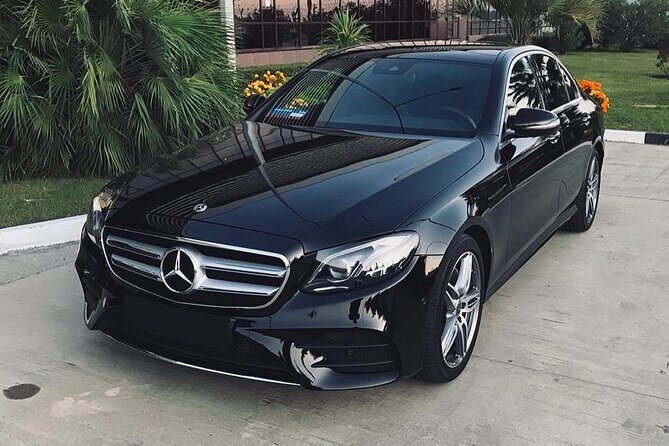
The vehicle is air-conditioned, and bottled water is included. That sounds simple, but on a long day it matters. It helps you arrive fresher and ready to walk and stand at viewpoints instead of arriving already worn down.
If you want to avoid the stress of buses and transfers, this tour’s approach is a strong fit. It’s also handy for first-time visitors who want the route story without needing to research each stop ahead of time.
Khayelitsha, Sir Lowry’s Pass, and Steenbras Dam: the route before the coast
The tour’s drive east out of Cape Town is where you start learning how the region functions. One of the early highlights is the pass-through of Khayelitsha, which in Xhosa means our new home. It’s described as the biggest township in Cape Town, with about half a million people, and many residents commute daily for work using public transport.
You also get named context along the way, which is exactly the kind of detail that makes a drive feel like more than just moving from A to B. The route includes Somerset West and Sir Lowry’s Pass, named after Sir Galbraith Lowry Cole (noted here as a governor of the Cape in 1828). That kind of historical naming doesn’t take long, but it gives you something to look for and remember.
Then there’s Steenbras Dam, one of the dams that supplies water to the province. This stop-through matters because it quietly explains a lot about the area: people live and farm here, and water systems are part of the story.
What to consider: because these are mainly drive-by moments, don’t expect long walking tours at every inland stop. You’ll be watching, listening, and using the time efficiently.
Elgin Valley and Appletizer notes: how food culture sneaks into the drive
As the route continues, you pass through Elgin Valley, described as the birthplace of Appletizer. You’re getting a pop-culture food detail that feels oddly specific—in a good way. It’s the type of small note that makes the day feel local, not generic.
After that comes the shift toward the coast and farming towns. The tour’s rhythm is basically: learn a bit, travel a bit, then break up the drive with coastal and agricultural stops that change the scenery and the pace.
Hermanus stop and whale watching window (July to November)
Hermanus is a key part of the route. It’s described as the bread basket of South Africa because of its warm climate and humid winters, which are said to be ideal for wheat cultivation. That agriculture note sets up why the area has long been an important service and food zone.
Hermanus is also the whale connection. The tour frames Hermanus as a capital for whales, specifically mentioning southern right whales. It explains that in earlier days they were called right whales because they would come close to shore or boats, making them easier to catch—hence the name.
If you’re traveling during the whale season, you get an opportunity to plan for whale watching in Hermanus from July until November. That date range is useful because it stops the guessing. Even if you don’t get whales on the day, the town itself is clearly set up for the whale identity, with ocean and mountains around you.
Practical note: this tour is time-limited, so plan to be ready for a decent walk and photo stops at the coast. The day moves on to the next towns afterward.


Caledon and Bredasdorp: farmland service hubs with real pace
After Hermanus, the itinerary moves through Caledon, described as mainly agricultural, with grain production and some stock farming. Then you pass Bredasdorp, which is described as the main economic and service hub in the Overberg region.
These stops matter for a reason beyond geography. They show you how the region’s economy runs: farming produces the base, and towns like Bredasdorp act as the service center. When you reach Cape Agulhas later, that context makes the coast feel less isolated.
What to watch for: these are not luxury-stop type moments. You’re seeing working towns and getting the sense that this is lived-in South Africa, not only a sightseeing route.
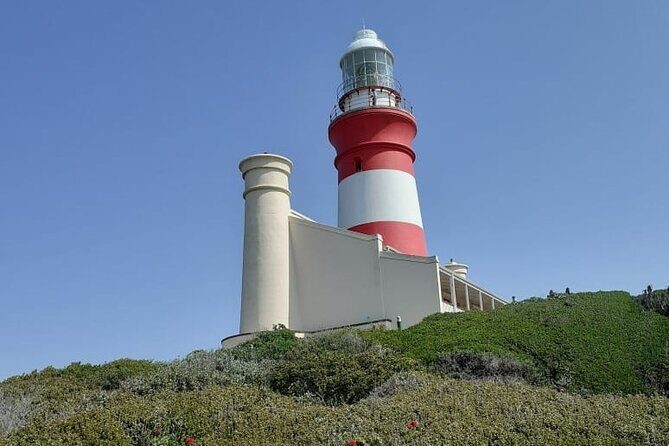
Cape Agulhas finale: the Indian meets the Atlantic (and the lighthouse fee)
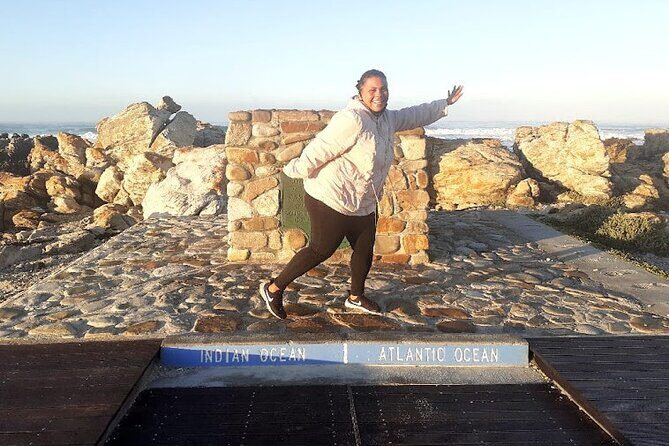
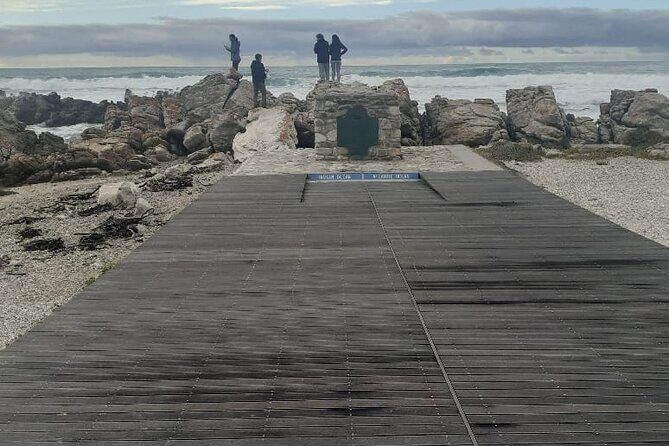
The last stop is Cape Agulhas, where the two oceans meet. This is the payoff: you’re at the southernmost point of Africa, and the tour frames it as the place where the Indian Ocean and Atlantic Ocean converge.
There’s also an important detail for planning your budget. The entrance fees at the Cape Agulhas Lighthouse are not included. If you want the lighthouse area and think you’ll pay to enter, add that extra cost before you go. The tour does give you the chance to experience the area; it just doesn’t bundle every entry expense.
How to get the most from this end point: keep expectations flexible. The oceans are the main event, but weather and light can change the feel of a viewpoint fast. If the sky is dramatic, lean into it. If it’s clear, take your time with the wide views.
Return via Elim and Gansbaai: mission town charm and shark territory
On the way back, the tour route adds more variety. You drive through Elim, described as a town established in 1824 by German missionaries as a Moravian Mission station. It’s said to be dominated by white fisherman’s cottages, with around 2,000 inhabitants.
That mission-station detail gives Elim a distinct identity. It’s one of those stops that can feel like a pause in the day, and the small population figure helps you understand why it doesn’t feel like a big city stop.
Then there’s Gansbaai, a small fishing town described as home to the Great White Shark. The tour positions it as being in the Overberg region with a population of about 15,000 people. Even if you don’t plan shark-focused activities, it’s another way the region’s coast is connected to wildlife and fishing life.
The return drive is still part of the experience, because you’re not simply heading home. You’re seeing more of the coast culture before the day ends in Cape Town.
Guide quality and small-group feel: why it improves the whole day
The tour is listed as having a maximum of 60 travelers, which helps keep the day from feeling like a cattle schedule. It won’t feel like a private tour either, but smaller numbers make it easier to hear route commentary and follow the rhythm at stops.
Guide quality is where a long road trip becomes memorable. One feedback point that stands out is about a guide named Johnny, highlighted for being very knowledgeable and informative on the route. Even when the stops are short, a good guide can turn them into a story you’ll actually remember.
You’ll also see the tour emphasizes clear communication. In one case, a prior traveler described getting pickup spot and time confirmation a day before travel and arriving on time. That kind of practical reliability matters more than people think, especially on a day trip.
Price and value: how $259.73 fits a full day
At $259.73 per person, this tour isn’t the cheapest way to reach Cape Agulhas. But it’s also not priced like a luxury private vehicle day.
What you’re paying for is the full package: hotel pickup and drop-off, an air-conditioned vehicle, a driver-guide, and bottled water. You’re also paying for a guided route with commentary and multiple regional stops, not just a straight drive to the tip.
What’s not included is equally important: lunch and Cape Agulhas Lighthouse entrance fees. That’s normal for many tours, but it does affect value. If you’re the type who buys snacks during stops anyway, you’ll likely keep this easy. If you pack food, plan around it with the reality that lunch isn’t built into the price.
A simple way to think about it: if you would otherwise spend money and time coordinating transport, then this price can feel fair. If you already have a rental car and you like driving solo with your own playlist, you might compare it to your own costs.
One more detail: this tour is often booked about 51 days in advance on average. That’s not a guarantee of availability, but it suggests it’s popular. If Cape Agulhas is a must-do for your trip, it’s smart to lock it in early.
What this tour is best for (and what it’s not)
You’ll likely enjoy this tour most if you want a one-day overview of the region with guided meaning behind the scenery. It’s also a good pick if you’re visiting Cape Town for the first time and don’t want to spend hours planning a route across provinces and towns.
It’s a solid choice for people who care about context: Khayelitsha, named passes, water infrastructure, farming zones, and whale-country notes all come together on the same itinerary.
What it’s not ideal for: if you hate long drives or want long, slow exploring with lots of independent time at each stop, you may find the day moves too quickly. It’s designed as a guided route, not a choose-your-own-adventure.
Should you book this Cape Agulhas tour?
If you want the southernmost point of Africa with less logistics stress and more regional context, I’d say yes. The combination of door-to-door pickup, air-conditioned transport, a guide-led route, and the final two-ocean Cape Agulhas viewpoint is a strong day-trip formula.
Book it if:
- Cape Agulhas is on your bucket list and you want a guided day that feels efficient
- You’d rather ride than plan local transport
- You’re traveling in July to November and want the option for Hermanus whale watching
Skip it (or consider an alternative) if:
- You’re only interested in getting to Cape Agulhas and back as cheaply as possible
- You want lunch and all entrance fees included automatically
- You prefer more free time at each stop rather than a structured route
FAQ
How long is the Cape Agulhas tour?
The tour runs about 8 to 9 hours.
Do I get hotel pickup and drop-off in Cape Town?
Yes. Hotel pick up and hotel drop off are included, and pickup is arranged from your accommodation in Cape Town.
Is lunch included?
No. Lunch is not included.
Are entrance fees at the Cape Agulhas Lighthouse included?
No. Entrance fees at Cape Agulhas Lighthouse are not included.
When is whale watching possible in Hermanus?
The tour notes that whale season is from July until November, and whale watching can be done in Hermanus during that window.
What’s included in the price besides the guide?
You get bottled water, an air-conditioned vehicle, a driver-guide, and hotel pickup and drop-off, plus a mobile ticket.