REVIEW · JOHANNESBURG
Johannesburg Soweto Highlights Tour
Book on Viator →Operated by Hedone Afrika Travel and Leisure PTY(Ltd) · Bookable on Viator
Mandela’s footsteps, packed into one focused day. I like that this private route tackles major Soweto and downtown Johannesburg stops fast, with pickup and air-conditioned transport so you lose less time getting around. You’ll hit headline sites like FNB Stadium, Mandela House, Hector Pieterson Museum and Memorial, and Constitution Hill without bouncing between separate tours.
My second favorite part is how the day connects names to moments. I especially love the pairing of the Calabash stadium and the 1990 Mandela speech, then sliding into Vilakazi Street for the rare story of two Nobel Peace Prize laureates living on the same road. It helps you understand Soweto as more than a list of places.
One thing to consider: the timing is condensed for a tour window that can be 1 to 5 hours, and some sites are heavy. If you’re hoping to include a specific extra place, I’d confirm it in advance, because in past feedback a planned extra stop like Regina Mundi didn’t always fit the day’s schedule.
In This Review
- Key things to know before you go
- How the route feels: tight timing, big meaning
- FNB Stadium: the Calabash and Mandela’s 1990 moment
- Diepkloof Park: government housing loans and local nicknames
- Chris Hani Baragwanath Hospital: scale you can’t ignore
- Orlando Towers: cooling towers, murals, and jump-night energy
- Vilakazi Street: a Nobel Peace Prize street in one line
- Mandela House: the modest home behind the global icon
- Hector Pieterson Museum and Memorial: the 1976 protest story
- Constitution Hill: a former prison that now argues for rights
- Braamfontein and Newtown: graffiti, science, and an industrial cathedral
- Downtown Johannesburg footnotes: Mandela and Tambo, plus gold traces
- Price and value: what $113.32 really buys you
- Who this tour is for (and who should skip it)
- Should you book the Johannesburg Soweto Highlights Tour?
- FAQ
- How long is the Johannesburg Soweto Highlights Tour?
- Where does the tour start?
- Is transportation included?
- What is included in the price?
- Is lunch included?
- Are tickets included for all stops?
- Is this a private tour?
- Do I get a mobile ticket?
- Is it easy to find the tour area?
- Can I get a full refund if I cancel?
Key things to know before you go
- Private, only-your-party touring with pickup from your preferred location, including hotels or a train station
- Air-conditioned vehicle + bottled water, which makes the logistics much easier when you’re hopping around Joburg
- Soweto plus downtown culture stops: you don’t just do Mandela landmarks; you also get Braamfontein/Newtown art and science stops
- Admission costs vary by stop: Mandela House is included, while Hector Pieterson Museum and Constitution Hill are not included
- The day mixes light stops and serious stops like the hospital and memorial sites, so plan your energy
- Average booking timing is about 43 days out, so it can help to lock in your dates early
How the route feels: tight timing, big meaning
This tour is built for people who want maximum payoff per hour. You get pickup, you ride in an air-conditioned vehicle, and you move from site to site with short timed visits. Even if the overall duration is listed as 1 to 5 hours, the structure is clear: you’re seeing the highlights, not parking for a full day inside one museum.
That matters because Soweto and Johannesburg can eat time fast if you rely on ad-hoc transport. Here, the tour handles the movement and keeps you oriented. I like that you also get a mobile ticket, which cuts down on the usual stress of finding paperwork when you’re already on the move.
You can also read our reviews of more tours and experiences in Johannesburg.


FNB Stadium: the Calabash and Mandela’s 1990 moment
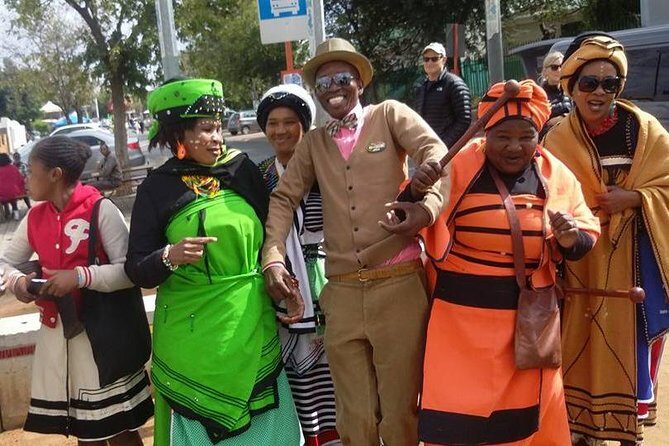
FNB Stadium is the opening act, and it’s a good one. It’s famous for its unique design, nicknamed the Calabash or African Pot after its reconstruction in time for the first ever African World Cup in 2010 (costing R3.3 billion). If you’ve only seen soccer stadiums described as blunt concrete, this one will reset your expectations.
The more meaningful part is why it appears on this tour. Mandela’s first speech from this venue happened in 1990, just days after his release from prison, where he served 27 years. The stadium then hosted some of South Africa’s biggest sports and music events, including the opening and closing ceremonies and the final of the 2010 FIFA World Cup, plus the Africa Cup of Nations final in 2013.
If you’re wondering what you’ll actually feel during a short stop: you’ll get the headline context quickly. This is the moment where the tour starts pulling you from architecture into lived political history.
Diepkloof Park: government housing loans and local nicknames
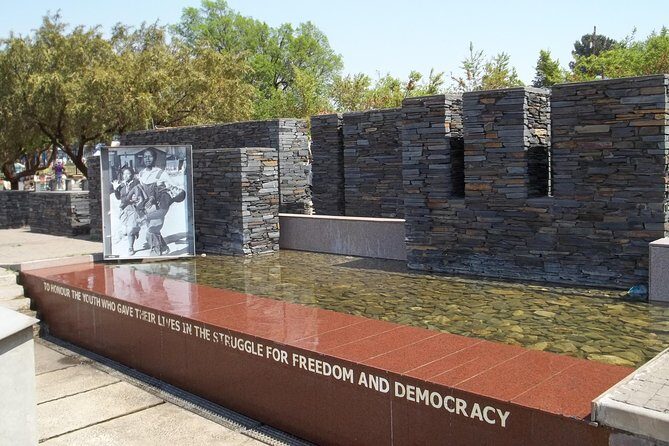
Next comes Diepkloof Park, a place that sounds like a simple green stop but carries social meaning. Residents call it Rich Man’s Acre because the stands were bigger, tied to an area intended as more exclusive. Another local shorthand you may hear is DK.
The key context here is the housing scheme behind Diepkloof Extensions. Middle to upper class Black families, largely state-employed professionals (plus some privately employed professionals), were offered 100% loans for the stand and structure as part of government housing. That detail gives the neighborhood a deeper layer than you’d get from a quick look.
Practical note: this is one of the stops where you may simply drive, view, and learn. It’s not a museum setting, and the value comes from the explanation you get along the route.
Chris Hani Baragwanath Hospital: scale you can’t ignore
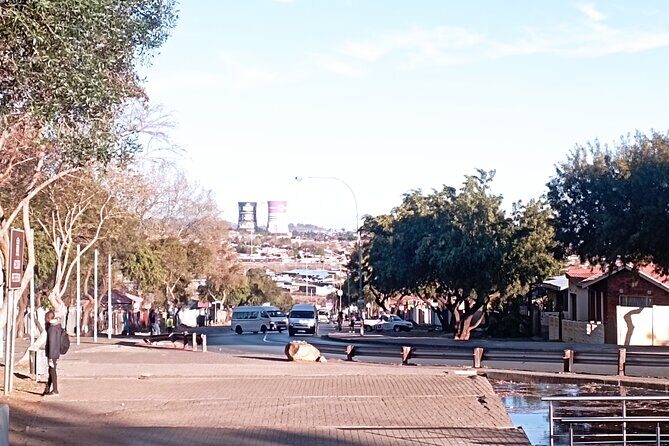
Then the tour heads to Chris Hani Baragwanath Hospital, and it shifts tone fast. This isn’t a monument stop—it’s a working health facility with huge operational scale. The hospital is described as the third largest in the world, covering about 173 acres with roughly 3,200 beds and around 6,760 staff members.
The numbers keep stacking up: 429 buildings with a total surface area of 233,795 m2. About 70% of admissions are emergencies, including approximately 160 victims of gunshot wounds per month. It also handles large daily volumes, with accident, emergency, and ambulance services counting over 350 daily patients. Yearly totals are about 150,000 inpatient and 500,000 outpatient cases.
There’s also a bit of specialization called out in the tour description, like the ophthalmology wing and St John Eye Hospital (111 beds and around 50,000 patients per year) and the maternity hospital with about 60,000 patients per year.
This stop can be emotionally intense. If you’re sensitive to medical realities, give yourself a moment before you move on. I appreciate it because it stops the day from becoming only ceremonial; it reminds you that modern South Africa is also about ongoing systems and urgent needs.
Orlando Towers: cooling towers, murals, and jump-night energy
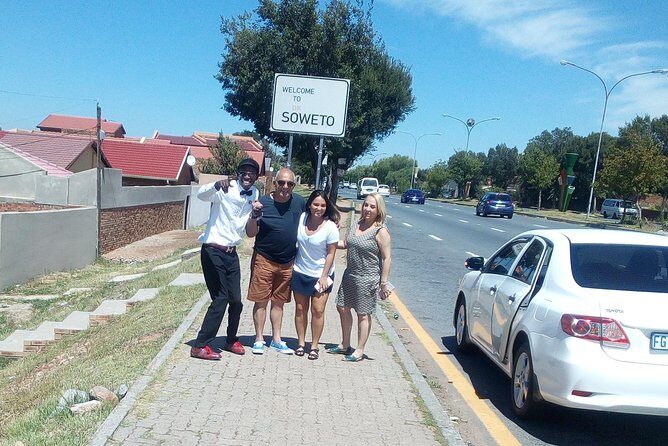
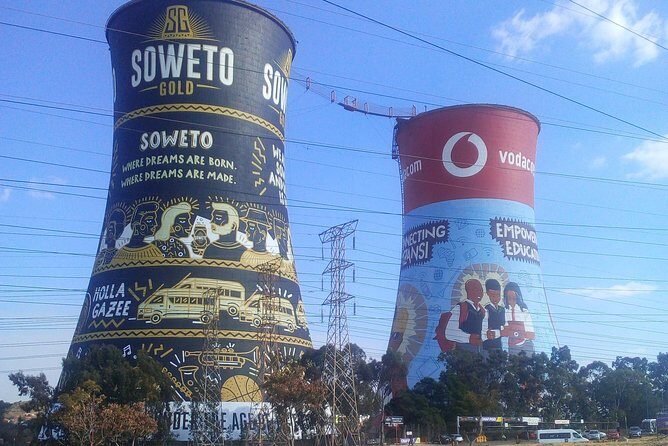
Orlando Towers are a standout landmark in Soweto. They were built in 1951 to supplement a spray pond cooling system that had reached its capacity. Instead of pulling new water sources, the spray ponds were supplied by sewage effluent from the Klipspruit Sewage Works—an approach described as the first in South Africa to use that ready supply of coolant liquid.
The towers themselves have two very different roles today: one is painted as an advertising billboard, and the other contains the largest mural painting in South Africa. And yes, the area has a reputation for adventure sports, including bungee and BASE jumping from a platform between the top of the two towers, plus bungee swings into one tower.
If you like pop culture connections, there’s also a note that the towers have been used for a Fast Forward on The Amazing Race (season seven). That’s fun, but the real value for me is understanding how industrial infrastructure became a public landmark.


Vilakazi Street: a Nobel Peace Prize street in one line
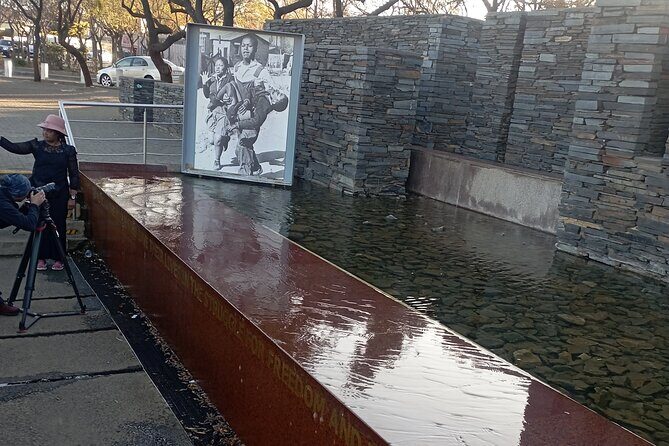
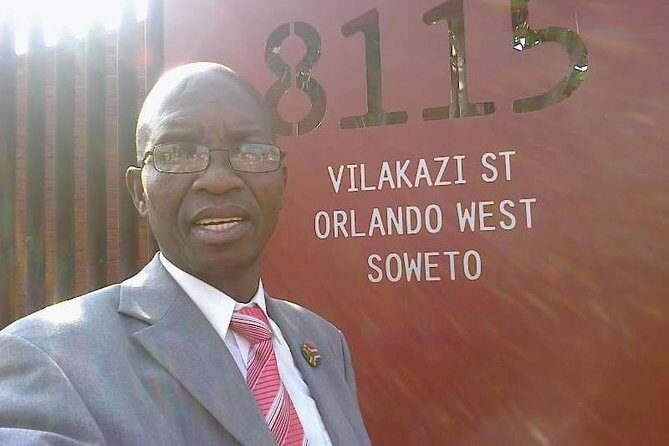
Then you reach Vilakazi Street, the one street in the world that has had two Nobel Peace Prize laureates as residents: Nelson Mandela and Archbishop Emeritus Desmond Tutu. That fact alone is worth the stop. But the tour also gives you the name origin: Vilakazi Street is named after Dr Benedict Wallet Vilakazi, a writer and educator who wrote the first Zulu poetry book published.
This part of the day is where you start seeing Soweto as personal rather than political. You’re not just looking at a site; you’re walking through the idea of community, identity, and influence.
Expect a quick visit. The benefit is that the learning comes in a short window, so you’re not stuck trying to piece together the story on your own.
Mandela House: the modest home behind the global icon

Mandela House sits on the corner of Vilakazi and Ngakane streets in Orlando West. It’s described as a modest home where Mandela and his family lived from 1946 to the 1990s.
The tour context matters. Mandela lived there with his first wife, Evelyn Ntoko Mase, and after his divorce with his second wife, Winnie Madikizela-Mandela. Mandela himself didn’t spend much time at the home once his anti-apartheid role demanded it—he went underground after his arrest in 1962. Winnie Madikizela-Mandela continued living there with their two daughters, Zenani and Zindzi, until she was banished to Brandfort in 1977.
When Mandela was released from prison in 1990, he moved back to the house for a short 11 days before moving to more secure premises. Even with a limited visit, it’s a powerful contrast: a small home tied to a life that changed world history.
This stop has admission ticket included, which is a nice value add because it reduces one of the common hassles: paying separately in the middle of a packed day.
Hector Pieterson Museum and Memorial: the 1976 protest story
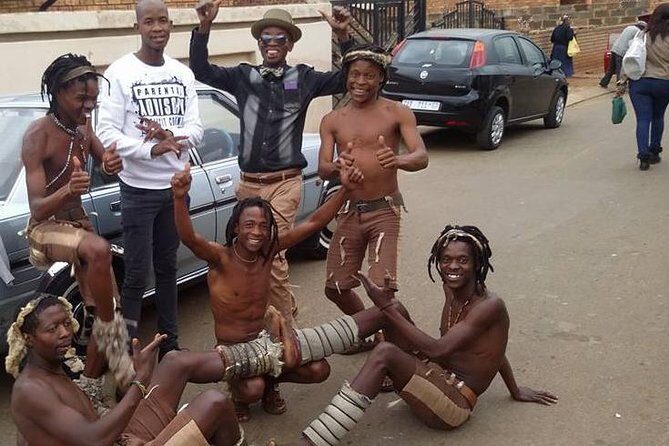
Hector Pieterson Museum and Memorial is one of the day’s most important stops, and it’s also one where the emotional weight is real. On June 16, 1976, Soweto high school students protested against the mandatory use of Afrikaans as a language of instruction in black secondary schools.
The planned route matters: students intended to meet at Orlando Stadium and then march to the regional offices of the Department of Bantu Education to raise their grievances with authorities. The tour description highlights protest placards and slogans, including Away with Afrikaans and Amandla awethu (Power to the people), plus Free Azania (Free South Africa). They also sang Nkosi Sikelel’ iAfrika (God Bless Africa), now the basis for South Africa’s national anthem in its democratic era.
The key practical detail: the admission ticket is not included, so you should expect there could be an extra cost here depending on what’s required at the time you visit.
If your schedule is short, I’d focus your time on the story flow: why the protest started, how it moved through Soweto, and what language policy represented. That’s what makes a short museum stop feel meaningful instead of rushed.
Constitution Hill: a former prison that now argues for rights
Constitution Hill is described as a living museum of South Africa’s journey to democracy. This site started as a former prison and military fort, and today it is home to the Constitutional Court, which endorses the rights of all citizens.
That progression is the point. You’re physically moving through a place built for control, then shifting into a place built to protect rights. Even if your visit is brief, it helps you read the country’s transition with your eyes, not just your phone.
This stop also has admission ticket not included, so budget a little extra if you want full access inside.
Braamfontein and Newtown: graffiti, science, and an industrial cathedral
After Soweto’s memorial weight, the tour pivots into Johannesburg creativity. Braamfontein is described as a neighborhood where creative energy shows up in public art installations and colorful graffiti murals. It’s a lighter change of pace, and it gives your day some breathing room.
Then you cross into Newtown area themes with several stops packed in. You’ll see Mandela Bridge, named after Nelson Mandela. It’s a 284-metre-long cable-stayed bridge that crosses over 42 operational railway lines, linking Braamfontein and the north of Johannesburg to Newtown near the city’s central business district.
From there you have a science and learning stop in Sci-Bono, described as a world-class science centre supporting maths, science, and technology education with interactive experiences aimed at building South Africa’s science, engineering, and technology capacity.
Finally, you get Turbine Hall, built between 1927 and 1934 as the largest of Johannesburg’s three steam-driven power stations. It’s now an iconic building in Newtown’s art and culture precinct. It’s one of those spaces where the architecture does half the talking: big, industrial, and designed for human scale despite its origin as infrastructure.
If you want a day that doesn’t only focus on politics, this section is the release valve.
Downtown Johannesburg footnotes: Mandela and Tambo, plus gold traces
The route also includes downtown Johannesburg details that feel like footnotes until you notice how much meaning they carry. One stop points to attorneys’ offices with a brass plate reading Mandela and Tambo, dated late 1952. The description places you in the context of young partners of South Africa’s first black-owned law firm busy at work soon after the National Party victory.
Then there’s Ferreira’s mine stope. It’s in the basement of the Standard Bank headquarters, described as one of the city’s earliest gold prospecting sites. The long-forgotten mine entrance was discovered in the 1980s during construction of the Standard Bank building and preserved as a small museum. The stope is named for Ignatius Phillip Ferreira, described as a farmer and soldier who later became a gold prospector, with a city district named after him.
I like stops like this because they don’t scream for attention. They quietly show you that Johannesburg’s story includes industry, law, and underground layers—literally underground layers.
Price and value: what $113.32 really buys you
At $113.32 per person, this is priced like a short, efficient highlights day with serious named stops. What makes it feel like value is what you get included: private transportation, an air-conditioned vehicle, bottled water, and all fees and taxes.
That’s also why the price feels fair even if you don’t spend hours in museums. The heavy lift here is logistics: driving the route, coordinating stops, and keeping you comfortable. You’re not paying extra for transport hassles on your own.
The main cost to watch is what’s not included: lunch. Also, some admissions are included and some aren’t. Mandela House is marked with admission ticket included, while Hector Pieterson Museum and Constitution Hill are listed as not included. Other stops are labeled free, such as FNB Stadium, Diepkloof Park, Orlando Towers, Vilakazi Street, and Braamfontein.
So the best way to budget is simple: assume you may pay for at least one major museum ticket depending on what you want to access fully.
Who this tour is for (and who should skip it)
This tour works best if you:
- Want a first-day overview of Soweto and key Joburg sites
- Prefer private routing over juggling buses or rideshare
- Like learning quickly with guided context, then moving on
You might want a different format if you:
- Want long, slow museum time at Hector Pieterson or Constitution Hill
- Have lots of specific must-see extras beyond the main route and need maximum flexibility
- Prefer places that are mostly light and scenic, since the hospital and memorial stops bring real weight
Should you book the Johannesburg Soweto Highlights Tour?
Yes, if you want a guided, efficient way to see the biggest Soweto and downtown landmarks without spending your vacation time solving transport. The tour’s core strength is practical: pickup + air-conditioned comfort + a tight route that still covers meaningful stops like Vilakazi Street, Mandela House, Hector Pieterson, and Constitution Hill.
I’d book with a little extra intention if you care about ticketed museum access, and I’d confirm any extra site you’re hoping to include. If your priority is a short, structured highlights day with strong thematic connections between Mandela’s legacy and Johannesburg’s broader story, this is a solid pick.
FAQ
How long is the Johannesburg Soweto Highlights Tour?
The duration is listed as 1 to 5 hours (approx.).
Where does the tour start?
Pickup is offered from your preferred location, such as your hotel or a train station.
Is transportation included?
Yes. The tour includes private transportation in an air-conditioned vehicle.
What is included in the price?
Included items are private transportation, air-conditioned vehicle, bottled water, and all fees and taxes.
Is lunch included?
No. Lunch is not included.
Are tickets included for all stops?
No. Mandela House has admission ticket included, while Hector Pieterson Museum and Memorial and Constitution Hill are listed as admission ticket not included. Other stops are marked as free.
Is this a private tour?
Yes. It’s described as a private tour/activity, and only your group will participate.
Do I get a mobile ticket?
Yes. A mobile ticket is included.
Is it easy to find the tour area?
It’s described as near public transportation.
Can I get a full refund if I cancel?
The policy is free cancellation. You can cancel up to 24 hours in advance for a full refund.