REVIEW · JOHANNESBURG
LocalPlaces Understanding Johannesburg Walking Tour
Book on Viator →Operated by LocalPlaces · Bookable on Viator
Johannesburg clicks into place on foot. This tour feels like a smart first introduction because you walk the inner-city’s Wiser West while hearing how the gold-rush city grew, declined, and is now regenerating. I love the storytelling that links street-level details to big political and economic shifts, and I love the architecture-focused stops, including the Shadow Boxer area connected to Mandela and Tambo’s old offices; the only real drawback is that it depends on good weather, so poor conditions can mean a change of plan.
You’re out for about 4 hours, starting at 2 Pritchard St at 9:00 am and ending back at the same meeting point. Expect a paced walk through Marshalltown’s gold-rush-era streets, past landmarks tied to the corporate mining district and later eras, plus a final look at Gandhi Square and the famous sculpture of young Gandhi as a working lawyer.
In This Review
- Key highlights at a glance
- Walking Johannesburg’s core: Marshalltown’s story in 4 hours
- What to pay attention to as you walk
- A quick reality check on the pace
- Main Street and the gold-rush corporate district: architecture with a timeline
- The Edwardian-era shift you can actually see
- Coffee shops and the present-day Johannesburg layer
- Stepping inside an abandoned stock exchange: stained glass and time travel
- Best way to enjoy the indoor moment
- Gandhi Square and the young lawyer sculpture: why it matters
- How this ties back to the big story
- The Shadow Boxer and Mandela & Tambo’s office footprint
- What to do with this information while you’re there
- From boom to decline to regeneration: how the tour connects the dots
- Why the regeneration angle is more than a feel-good ending
- Price and value: what $80.80 buys you in Johannesburg
- Timing, meeting point, and what to bring
- Who should book this walking tour (and who might skip it)
- Should you book the LocalPlaces Understanding Johannesburg Walking Tour?
- FAQ
- How long is the Johannesburg walking tour?
- Where does the tour start?
- What time does the tour start?
- Where does the tour end?
- Is there an admission fee for the main stops?
- Is the tour private?
- Is the tour outdoors?
- What is the cancellation policy?
- Are service animals allowed?
Key highlights at a glance
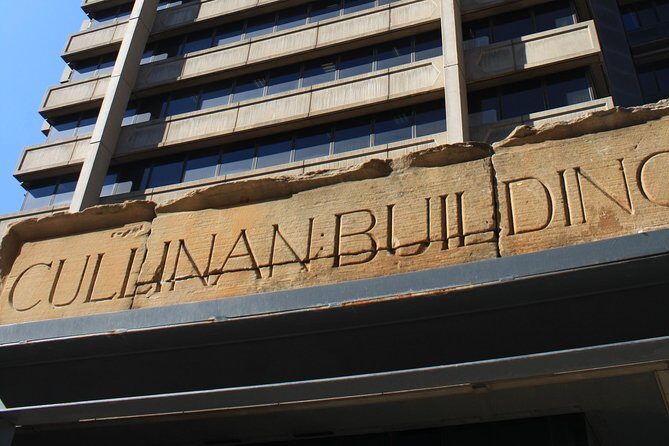
- Marshalltown orientation: You start in the inner-city area where mining and finance roots took hold
- Gold-rush to Edwardian to today: The walk stretches from early prosperity through downturn to current renewal
- Mandela and Tambo footprint: You’ll see the Shadow Boxer sculpture tied to their offices
- Gandhi Square visit: You pause at the central square and the sculpture of Gandhi as a young lawyer
- Architectural moments: You get a closer look at built heritage, including an indoor stop tied to a former stock exchange
Walking Johannesburg’s core: Marshalltown’s story in 4 hours
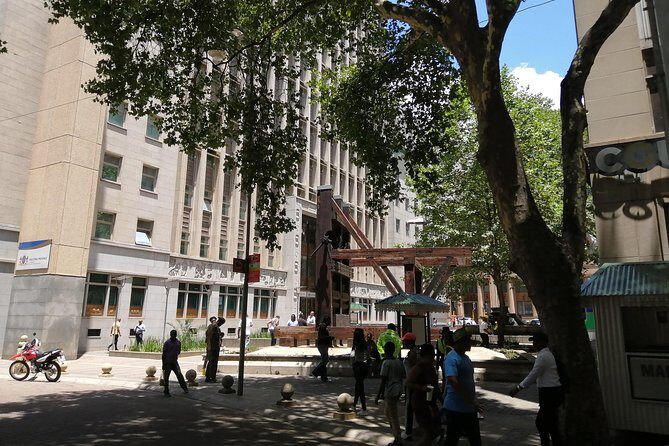
If you only have a day or two in Johannesburg, this is the walk I’d pick first. Not because it covers everything, but because it teaches you how the city’s center actually works. Johannesburg’s present-day energy can feel disconnected from its past until someone puts the timeline into your hands. This tour does that with a simple formula: follow the streets, read the architecture, and let the guide connect the dots from the gold-rush start to current renewal.
You’ll begin in Marshalltown, often seen as the older chunk of Johannesburg’s CBD. This matters because Marshalltown isn’t just about buildings. It’s about why the city formed the way it did—where mining money pooled, where financial institutions clustered, and how the inner-city shifted as those forces changed.
The guide’s approach is part of the value. One review specifically called out Charlie as a lively raconteur, and that kind of pacing makes a difference on a walking tour like this. You’re not standing around for long speeches. You’re moving, stopping, and getting just enough context to make each next corner make sense.
You can also read our reviews of more walking tours in Johannesburg



What to pay attention to as you walk
The tour is packed with historical cues, but the best way to enjoy it is to watch for three things:
- Architecture that hints at eras
Gold-rush prosperity left its mark, and later “glory days” did too. You’ll get mentions of the early 1900s Edwardian era, and you can often feel the shift in building styles as you go.
- How commercial space became social space
Johannesburg’s center isn’t frozen. As the city has regenerated, you’ll notice modern-day coffee shops and eateries popping up along Main Street. That contrast is one of the most practical lessons of the walk: decline and renewal can live on the same block.
- Places tied to leadership and law
The route doesn’t treat politics as a separate topic. Instead it threads through offices, courts, and legal life—so big names like Mandela, Tambo, and Gandhi land with meaning rather than just fame.
A quick reality check on the pace
This is a walking tour of about 4 hours. That’s a good length for first-timers, but you should still plan for being on your feet. Also, since it’s weather-dependent, you’ll enjoy it more if you dress for the conditions rather than assuming the weather will cooperate.
Main Street and the gold-rush corporate district: architecture with a timeline
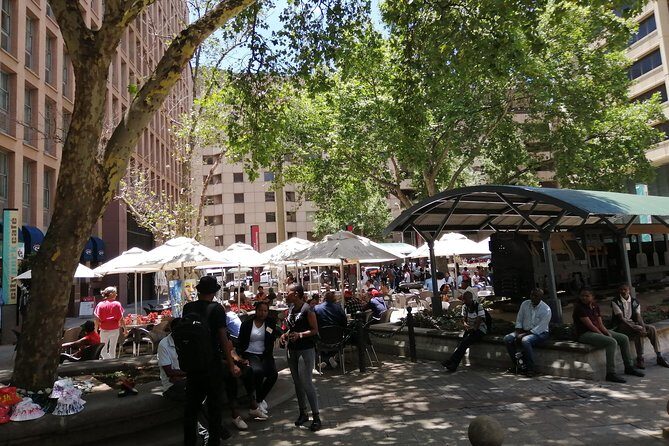
One of the clever parts of this tour is how it uses a single area to tell multiple chapters. From the start, you’ll move through the pedestrian-friendly Main Street area in the corporate mining district. This isn’t a generic “walk past shops” experience. The guide points out historic landmarks and explains how the mining-and-finance center shaped Johannesburg’s growth.
This is where the tour earns its title as an “astonishing” introduction. Johannesburg’s origin story can sound abstract until you see how it physically formed into a business district. You learn why companies clustered, why certain buildings rose, and how the city’s fortunes shifted as the gold-rush era moved from boom to something less stable.
The Edwardian-era shift you can actually see
The tour stretches beyond the early gold years into the plush Edwardian period of the early 1900s. That’s useful because it shows Johannesburg wasn’t only a mining camp turned city overnight. It matured into a place with its own style and ambition. When you hear those era references alongside what you’re looking at, the city’s changes feel less random.





Coffee shops and the present-day Johannesburg layer
You’ll also spend time in the area where today’s Johannesburg shows up: coffee shops and eateries along Main Street. That isn’t a throw-in. It’s part of the regeneration story, and it helps you understand what renewal means in real life. It’s not just governments repainting buildings. It’s people returning to the streets for work, food, and meeting up.
Stepping inside an abandoned stock exchange: stained glass and time travel
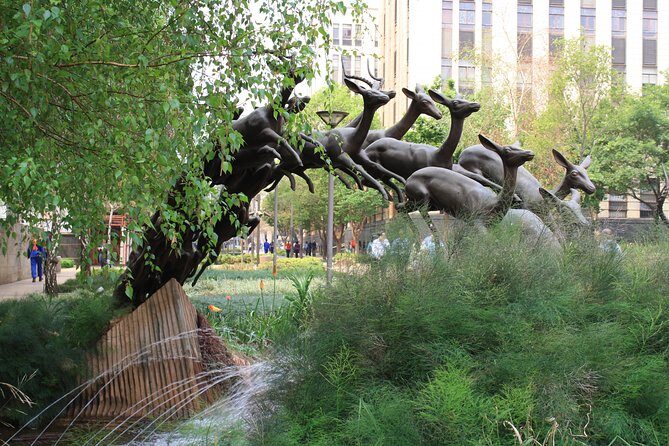
One of the most praised elements is the chance to go inside an abandoned stock exchange. A review highlighted the stained-glass windows, describing the feeling as like going back in time.
Even if you’re not a hardcore architecture fan, this is the kind of stop that changes how you remember the tour. Streets and sculptures are great, but interior spaces create a stronger contrast between the city’s past and its present. You’re seeing remnants of finance-era ambition, now living in a quieter reality. That’s exactly the emotional tone that helps the rest of the story land.
This stop also supports the tour’s overall message: Johannesburg has gone through a dramatic arc of rise and decline, and you can literally see proof of those shifts if you know where to look.
Best way to enjoy the indoor moment
Keep your eyes up and your pace steady. Interior heritage like this rewards attention to details—window patterns, materials, and how the space is shaped. If you move slowly here, the rest of the walk feels more meaningful because you’re carrying a mental image of what the city used to be.
Gandhi Square and the young lawyer sculpture: why it matters
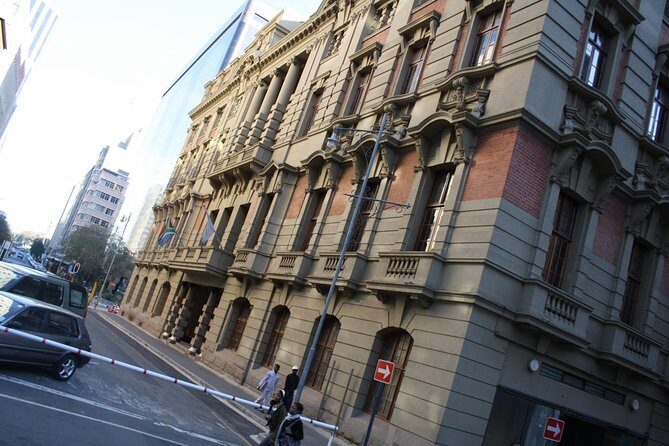
The tour’s second stop is Gandhi Square, and it’s not just a photo stop. You’ll view the sculpture of Gandhi as a young lawyer. The key detail is that Gandhi worked here as a business lawyer when he was a young man.
This is powerful because it reframes Gandhi as more than a distant symbol. You’re seeing his legal work placed in a Johannesburg setting tied to the city’s central space. When you understand that, the square becomes less like a landmark and more like a chapter.
How this ties back to the big story
By the time you reach Gandhi Square, you’ve already traced the rise-and-decline arc in the city’s center. The Gandhi stop adds a different dimension: the story isn’t only economic. It’s also about law, advocacy, and the way public spaces can hold political meaning.
So even though this stop is short (around 15 minutes), it works like a sharp punctuation mark.
The Shadow Boxer and Mandela & Tambo’s office footprint
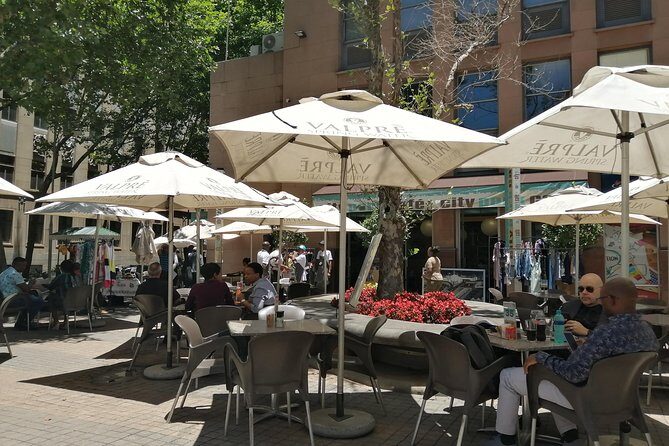
As you walk, you’ll also admire the Shadow Boxer sculpture, connected to the offices where Mandela and Tambo once worked. That moment is a reminder that leadership history isn’t limited to museums. Sometimes it’s embedded in street-level landmarks, waiting for someone to point it out.
I like this part because it turns a single sculpture into a story you can track. You’re not just looking at art. You’re linking it to where major decisions and organizing efforts happened. That’s what makes the walking format powerful: the city becomes a map of memory.
What to do with this information while you’re there
When you spot a landmark tied to Mandela and Tambo, ask yourself one practical question: what kind of work would have happened in that space? The tour’s framing helps you answer that in your head, and suddenly the sculpture feels less like decoration and more like evidence.
From boom to decline to regeneration: how the tour connects the dots
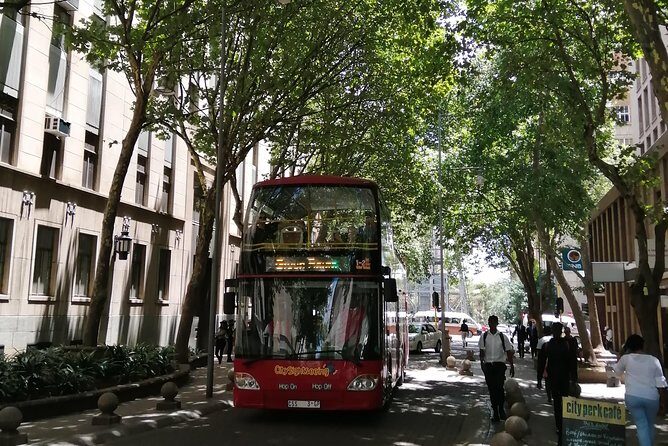
If there’s one thing this walk does well, it’s sequencing. You don’t just get a collection of interesting stops. You get a line that runs through them: pre-gold rush days, gold-rush boom, glory days, urban decline, and current regeneration.
That “whole-story” approach is valuable because Johannesburg’s center can feel confusing if you only look at the present. Buildings show multiple decades at once. Business patterns change. Streets shift in how they’re used. Without context, the city can feel like random layers. This tour gives you the order those layers belong in.
Why the regeneration angle is more than a feel-good ending
The tour’s ending isn’t only about optimism. It’s about how Johannesburg has been actively remade in the inner-city. When you see coffee shops and eateries alongside older architecture, you’re witnessing regeneration as lived experience. That’s different from hearing about it in an abstract way.
If you plan to explore more after the tour, this is the part that helps you do it smarter. You’ll know where you are in the city’s timeline and you’ll be less likely to miss the meaning of what you’re seeing.
Price and value: what $80.80 buys you in Johannesburg
At $80.80 per person for roughly 4 hours, you’re paying mainly for a structured guide-led experience. You’re not buying museum-style entries for those core stops; the stops listed for Marshalltown and Gandhi Square indicate admission is free there. So the cost is mostly about the guide time, route planning, and the storytelling that turns streets into context.
For first-time visitors, I think that’s fair value. It’s hard to replicate what a good guide does—especially in a city where the past and present sit so close together. And there’s also a practical advantage: you’re not doing this legwork alone. You get a ready-made order of sights, plus context for why each one exists.
The tour also notes group discounts, which can improve value if you’re traveling with friends or family. And since it uses a mobile ticket, you’ll spend less time wrestling with paper logistics.
Timing, meeting point, and what to bring

You’ll meet at 2 Pritchard St in Johannesburg, starting at 9:00 am, and the tour ends back at that same meeting point. That return-to-start detail is helpful because it means you don’t need to figure out a separate pickup or navigate to another end point.
Because it’s a walking experience and it requires good weather, I’d come prepared for changes in conditions. Wear comfortable walking shoes and bring a layer you can handle if the morning air shifts. If it’s a warm day, have water on hand, since you’ll be moving for most of the four hours.
Also, confirmation is received at booking time, and a mobile ticket is used. So double-check whatever device you’ll use for your ticket, then keep your day simple.
Who should book this walking tour (and who might skip it)
This tour is best for you if:
- You’re in Johannesburg for the first time and you want the inner-city to make sense fast
- You care about architecture, street-level landmarks, and how places shape political and economic stories
- You want a guided story that runs from the gold-rush era to today’s regeneration
You might skip this one if:
- You want a tour focused mainly on modern suburbs, nightlife, or topics that don’t relate to the CBD’s timeline
- You don’t handle walking well, or you’re visiting during a period when weather could disrupt outdoor plans
Should you book the LocalPlaces Understanding Johannesburg Walking Tour?
Yes, if you want a strong first introduction to Johannesburg’s center. The biggest reason is the sequencing: you walk a core inner-city district and get a full narrative arc instead of isolated facts. You’ll also get the kind of landmark moments that stick—the Shadow Boxer, the Gandhi Square sculpture connected to Gandhi’s legal work, and that praised indoor stop tied to a former stock exchange with stained-glass windows.
If your trip is short, treat this as your orientation walk. After it, you’ll have a mental map of how the city formed, why it declined, and what regeneration looks like on the street. That makes every later stop you choose feel more connected, not random.
FAQ
How long is the Johannesburg walking tour?
The duration is approximately 4 hours.
Where does the tour start?
The meeting point is 2 Pritchard St, Johannesburg, 2113, South Africa.
What time does the tour start?
The start time is 9:00 am.
Where does the tour end?
The activity ends back at the meeting point.
Is there an admission fee for the main stops?
Admission tickets for the listed stops are free.
Is the tour private?
Yes. Only your group will participate.
Is the tour outdoors?
It’s a walking tour and requires good weather.
What is the cancellation policy?
Free cancellation is available up to 24 hours in advance for a full refund.
Are service animals allowed?
Yes, service animals are allowed.